



Imagine IT without server virtualization software in 2026. Hard. Isn’t it? It’s the sole reason why workloads can shift around and across teams without breaking a sweat or draining budgets. Best part? Budgets stay controlled, and systems keep running even when something fails (unexpectedly).
For a long time, VMware was the go‑to choice, but things have changed in 2026. Complicated licensing, added costs, and security gaps have pushed many IT leaders to look elsewhere.
If you’re managing an IT team right now, the question is obvious: which server virtualization platform makes the most sense for your business? There are several strong contenders worth considering, and Sangfor HCI has quickly risen to the top as one of the most reliable VMware alternatives.
Top Traditional Hypervisors & Server Virtualization Software
Server virtual software heavily depends on the hypervisors that help the VMs connect to the physical servers (“what is hypervisor?” Read more about hypervisors on Sangfor blogs).
While VMware’s ESXi set the bar high for users, Broacom’s acquisition has changed a lot for users.
But, thankfully, VMware alternatives like Sangfor, Nutanix, and Microsoft Hyper-V have evened out the playing field. Here’s a list of hypervisors empowering the more transparent and affordable virtualization platforms of 2026:
These handle core virt but lack HCI integration.
Microsoft Hyper‑V
Hyper‑V is one of those tools that feels almost second nature if your company already runs on Windows Server. Since it’s built right into the operating system, you don’t have to worry about buying a separate hypervisor license, which makes it a smart pick for teams keeping an eye on budgets.
It’s not just about saving money, though. Hyper‑V brings solid features like live migration, clustering, and disaster recovery, so workloads can move around without downtime, and systems stay resilient. And if your environment is already tied into Active Directory, Hyper‑V fits in seamlessly—it feels less like an add‑on and more like a natural extension of what you’re already using.
Nutanix AHV
Nutanix AHV is another strong competitor in the hyperconverged infrastructure (HCI) space. It bundles compute, storage, and networking into one platform, managed through Prism—a clean, single‑pane interface.
AHV is known for resilience. Features like self‑healing clusters, non‑disruptive upgrades, and automated lifecycle management make it appealing for enterprises that can’t afford downtime. Nutanix has also built a strong ecosystem around AHV, with integrations for monitoring, automation, and hybrid cloud.
Why IT teams pick Nutanix AHV: polished HCI experience, strong resilience, and simplified management.
Red Hat OpenShift Virtualization
For organizations leaning toward cloud‑native, Red Hat OpenShift Virtualization is compelling. It lets you run VMs and containers side by side under Kubernetes using KubeVirt.
This means you can modernize at your own pace. Traditional workloads stay virtualized, while new applications run as containers. You apply the same GitOps, observability, and policy frameworks across both.
Why IT teams pick OpenShift Virtualization: unified operations for VMs and containers, fewer silos, and future‑ready automation.
Proxmox VE
Proxmox VE is a popular open‑source virtualization platform for SMBs and mid‑market enterprises. It combines KVM for VMs, LXC for containers, and supports ZFS/Ceph storage. With a clean interface, built‑in clustering, snapshots, and HA—plus strong community support—IT teams value its low licensing friction, flexibility, and enterprise‑ready features.
Sangfor HCI
Now let’s talk about Sangfor HCI, which has become one of the most talked‑about VMware alternatives. Sangfor HCI is a VMware Alternative that bundles virtualization, storage, networking, and security into one stack.
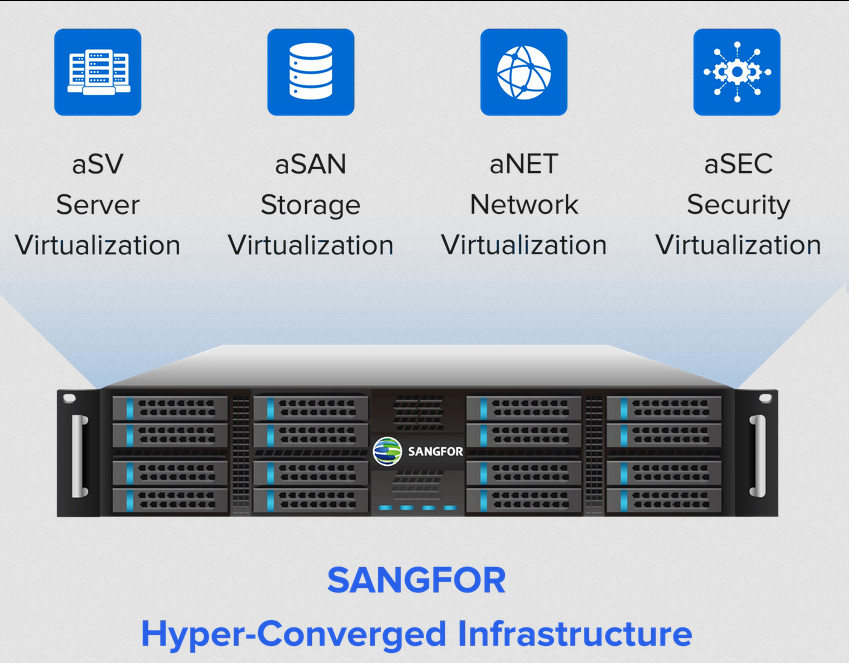
Unlike VMware, where you often need bolt‑on tools for firewalls or endpoint protection, Sangfor HCI converges security directly into its software stack through the built-in aSEC cloud security center.
By integrating Sangfor’s core security solutions like vAF and Endpoint Secure, the platform provides a unified security operation center for real-time ransomware prevention and vulnerability repair. This native integration ensures full visibility and governance across the entire stack, securing critical applications from the network perimeter down to the micro-segment level.
Pricing is straightforward. Sangfor HCI solves VMware licensing issues by offering flexible and cost‑effective pricing. No per‑core surprises, no hidden fees. Disaster recovery is practical too, with three‑node designs instead of complex five‑node requirements.
So, why is Sangfor one of the best VMware alternatives? The reviews on platforms like Gartner are transparent and place Sangfor among the most reliable HCI solutions.
Customers consistently rate Sangfor highly on Gartner Peer Insights and G2, noting strong product capabilities, deployment ease, and responsive support.
Why Sangfor Is the Top Choice
So why does Sangfor stand out among VMware competitors?
- Integrated Security: Sangfor HCI is the best VMware Competitor because it provides integrated security. With Athena NGFW, EPP, SWG, NDR, SASE, and XDR built in, you don’t need to glue third‑party tools onto your hypervisor.
- Simplified Operations: Management lives in a modern HTML5 console, not three different tools. IT teams save time and reduce complexity.
- Flexible Pricing: Sangfor HCI is a VMware Alternative that keeps budgets sane. Transparent pricing avoids the licensing headaches VMware customers often face.
- Proven Customer Satisfaction: Gartner Peer Insights shows Sangfor HCI with ~4.8/5 ratings and strong “willingness to recommend.” On G2, Sangfor is recognized as a Leader across infrastructure categories.
Whether the complex pricing of VMware is weighing you down, or it is the bundled approach you don’t like, your IT team now has options to switch. Sangfor provides a blend of affordable licensing, flexibility, and reliable customer support. It’s clearly one of the best VMware alternatives to pilot in 2026.
Choose what Your Teams Love
If you’re eyeing alternatives to server virtualization software your IT team is already using, you can refer to the options mentioned in this article. Quick suggestions? Read the licensing models and subscription terms and conditions before even considering a pilot project. While affordability and flexibility are undoubtedly important, don’t forget to consider your enterprise’s needs first.
If you want to migrate from VMware, then Sangfor HCI is the best VMware alternative. Sangfor HCI is a VMware Alternative. Teams love the TCO—lower opex, no NSX fees. Scales to thousands of VMs, global support. Guest post from Sangfor: Ditch the drama, go HCI. Your IT team’s future self thanks you. Thoughts?


